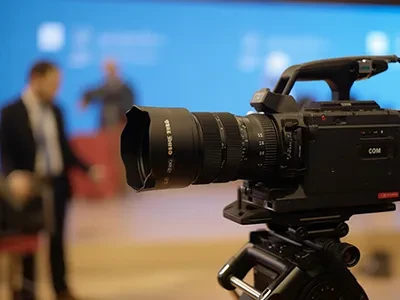
Experienced engineers share their real-world experiences and the benefits.
Author: Anna
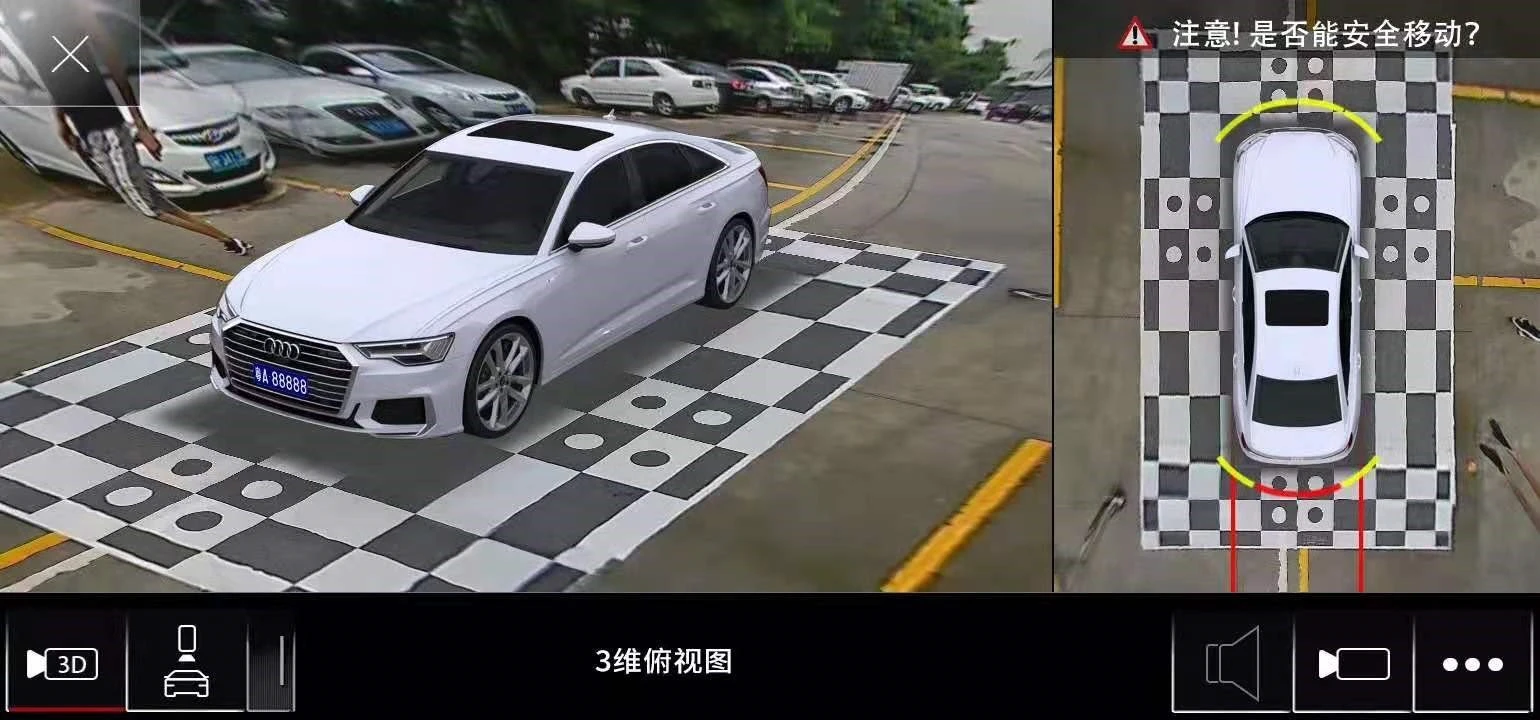
By 2025, the 360-degree panoramic surround view system has become a standard technology for the popularization of intelligent driving. Through breakthroughs in AI computing power technology, it supports integrated 3D panoramic view, transparent chassis, AI object recognition, dynamic trajectory tracking, and recording functions. From its initial development in 2012 with four cameras stitching together a 2D grid image, it has evolved to using 4-6 wide-angle cameras to automatically stitch together real-time 3D bird's-eye view images. Further extending the algorithm to meet the needs of different customers, it allows for the optional addition of 1-2 cameras while retaining the original factory rearview camera, significantly reducing procurement costs and helping drivers eliminate blind spots and easily navigate narrow parking spaces and complex road conditions. Especially in congested urban environments, this technology is an essential product that significantly improves parking safety. According to market data, the penetration rate in the Chinese market exceeded 50% in 2025, and international high-end models consider it a standard configuration.
System Overall Architecture
A typical 360° panoramic system consists of the following modules:
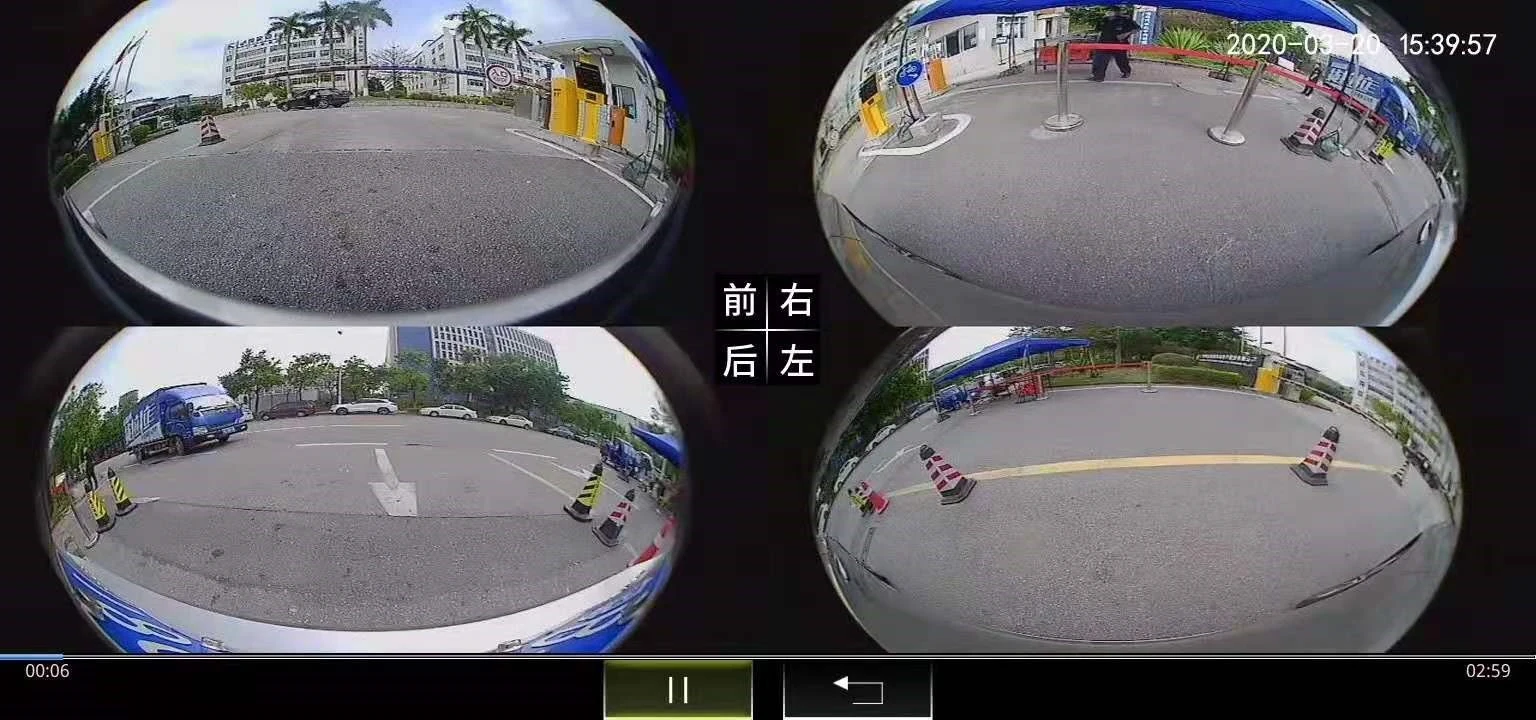
• Camera Hardware: Typically 4 cameras (front, rear, left, and right), expandable to 6 in high-end models. Utilizes fisheye lenses (FOV 170°-190°), with resolution upgraded from early VGA to 1080P AHD or IP transmission by 2025. Sensors are mostly CMOS (e.g., Sony IMX series), supporting HDR/WDR to handle strong backlighting.
• ECU (Electronic Control Unit): The core brain, integrating a SoC (e.g., NXP i.MX, TI TDA4, Qualcomm SA8155P, etc.). Responsible for video acquisition, distortion correction, stitching, rendering, and output.
• Display Unit: Central control screen or instrument cluster, supporting CVBS/AHD/LVDS/ETH transmission.
• Auxiliary Sensors: Steering wheel angle sensor (SAS), vehicle speed signal, used for dynamic trajectory generation.
Typical Installation Locations: Front camera integrated into the front grille emblem, above the rear license plate light, below the left and right rearview mirrors. This layout ensures an overlap of approximately 30%-50%, facilitating splicing.
Core Technology Process
The engineering implementation consists of the following key steps:
(1) Fisheye Lens Distortion Correction
Fisheye lenses introduce severe barrel distortion (radial distortion), which must be corrected before it can be mapped to a bird's-eye view. A commonly used polynomial model is:
r_u=r_d (1+k_1 r_d^2+k_2 r_d^4+⋯"")
Where r_d is the distortion radius, r_u is the ideal radius, and k_i is the distortion coefficient.
Correction Methods:
Offline Calibration: At the factory, intrinsic parameters (focal length, principal point) and distortion coefficients are obtained using a checkerboard calibration board to generate a Lookup Table (LUT).
Online Optimization: High-end systems support dynamic recalibration to compensate for drift caused by temperature/vibration.
(2) Perspective Transformation
Map the corrected image onto a virtual bird's-eye view plane (the ground is assumed to be flat). Use a homography matrix:
Left bracket 3 Formula Equation system x First derivative End Formula , y First derivative End Formula , w First derivative Device control 4 End Equation system Right bracket Equal to Uppercase H Left bracket 3 Formula Equation system x End Formula , y End Formula , 1 End Equation system Right bracket
The H matrix is obtained through calibration, independent for each camera. The virtual camera height is usually set to 2-4 meters to ensure a natural vehicle display scale.
(3) Image Stitching & Blending
Merge multiple images in the overlapping area to avoid seams. Common algorithms:
• Feature matching: SIFT/ORB extracts feature points, RANSAC estimates overlap.
• Illumination Consistency: Gain Compensation or Multi-band Blending eliminates brightness differences.
• Real-time Optimization: GPU/ISP acceleration; mainstream SoCs in 2025 can achieve 60fps latency-free stitching.
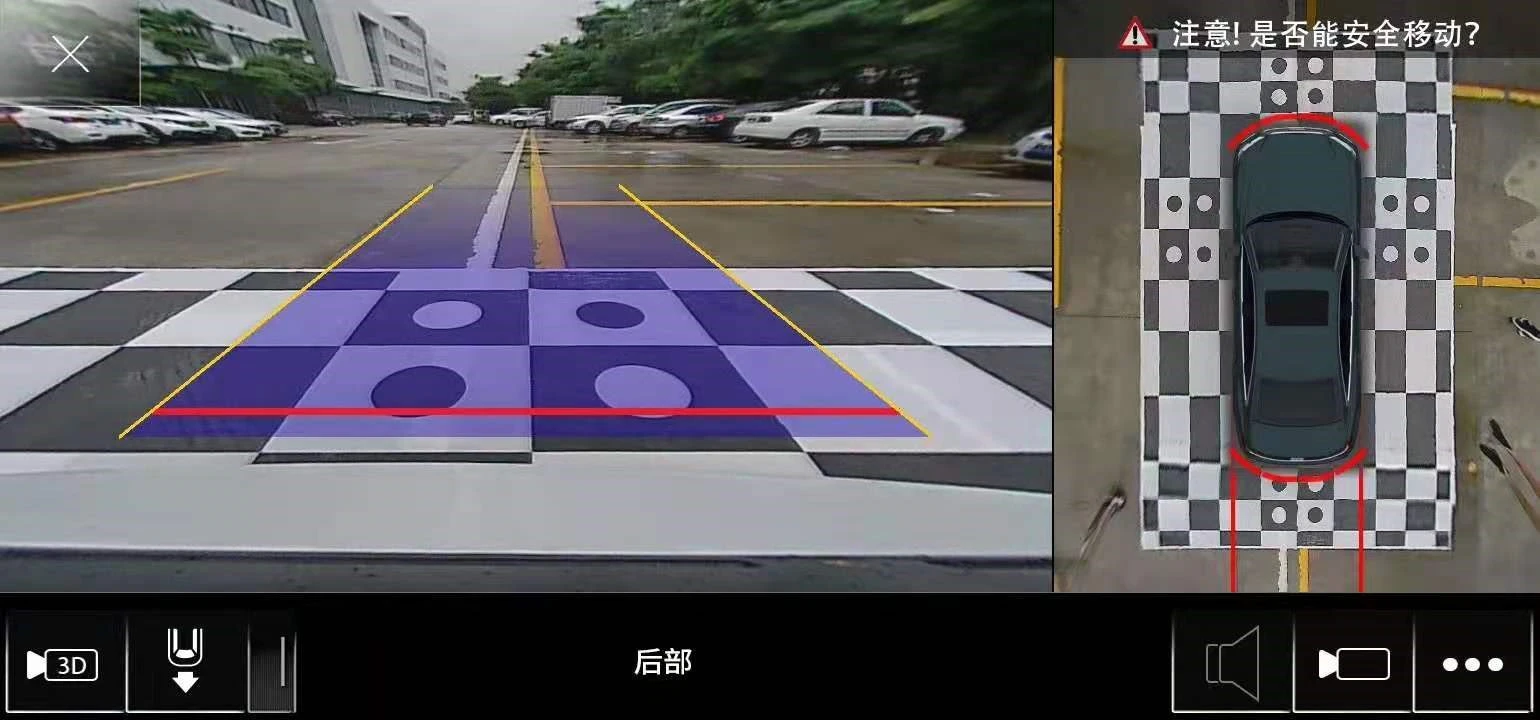
(4) Dynamic Trajectory and 3D Rendering: Dynamic trajectory calculates tire paths based on the Ackermann steering model. 3D mode renders a "transparent chassis" effect through depth estimation or preset vehicle models.
Engineering Challenges and Barrier
• Real-time Performance: Processing 4 channels of 1080P video requires >10GFLOPS of computing power; low-end SoCs are prone to lag.
• Robustness: Rain, snow, mud, and strong/low light environments can cause stitching failure. Solutions: AI semantic segmentation to mask dirty areas, or infrared supplemental lighting.
• Calibration Accuracy: An installation error of 1cm can cause stitching misalignment. Factories require precision fixtures; aftermarket systems rely on manual calibration apps.
• Cost and Power Consumption: Pre-installed systems require AEC-Q100 automotive-grade certification, resulting in high costs; aftermarket systems balance performance and price.
• Non-planar Ground: Real roads have slopes/potholes, rendering traditional Homography ineffective. High-end solutions introduce SfM (Structure from Motion) or integrate ultrasonic radar.
2025 Technology Trends
• AI Enhancement: Real-time neural network distortion correction, super-resolution, object detection (pedestrian/vehicle warning). • Fusion Perception: Combined with millimeter-wave radar/ultrasound, it achieves integrated parking and driving assessment (APA/RPA).
• Ethernet Transmission: Replaces traditional analog signals, supporting higher resolution and lower latency.
• Open Source and Standardization: The ROS2/AutoWare ecosystem accelerates development.
From an engineering perspective, the 360-degree surround view system is one of the most successful applications of computer vision in the automotive field. It simplifies the complex multi-view vision problem into a reliable product, greatly improving low-speed driving safety. In the future, with increased computing power and algorithmic advancements, it will further evolve towards L2+ automated parking.
A detailed explanation of 7 major benefits for drivers.
In urban driving environments, traffic congestion and limited parking spaces have become everyday frustrations. Many vehicles are equipped with reversing radar or a single camera, but significant blind spots still exist, leading to frequent minor collisions. Statistics show that over 70% of low-speed collisions in cities are due to blind spot issues. A 360-degree panoramic view system, using four or more fisheye cameras (front, rear, left, and right), stitches together a real-time bird's-eye view of the vehicle, completely eliminating blind spots. Below, we'll discuss in detail why it's worth installing, the actual user experience, and the practical benefits for drivers.
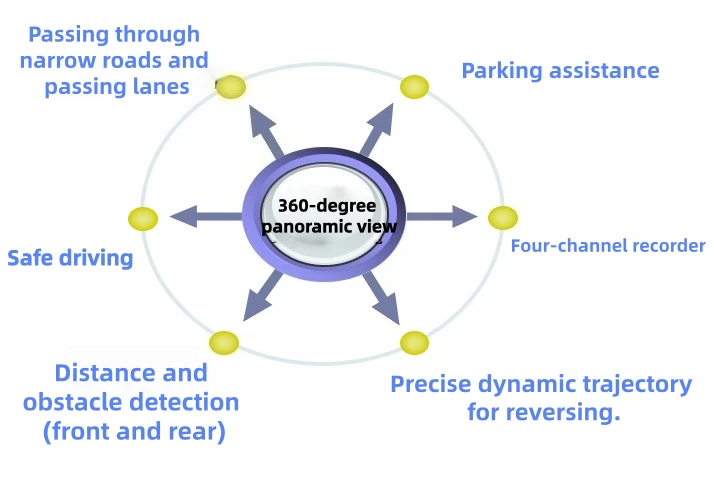
1.Completely eliminate blind spots and improve driving safety.Traditional rearview mirrors and single backup cameras can only cover a limited area, leaving blind spots around the A-pillars, C-pillars, and under the vehicle where pedestrians, vehicles, or obstacles can easily be hidden. A 360-degree system provides a complete, unobstructed bird's-eye view, allowing you to see everything around the vehicle as if looking down from the roof. This is especially beneficial when merging, changing lanes, or driving at low speeds, enabling you to detect potential risks in advance and significantly reduce the accident rate. New drivers and drivers of larger vehicles (such as SUVs and MPVs) benefit the most.
2.Parking your car is effortless, like magic; say goodbye to parking anxiety.
As urban parking spaces become increasingly narrow, parallel parking or reversing into a parking spot often requires multiple adjustments. The 360-degree camera system not only displays dynamic trajectory lines (which curve in real-time with steering wheel movements), but also supports 3D rendering and a transparent chassis view, allowing you to accurately judge the distance between the car body and the parking space. Many users have reported: "Previously, I had to lean out to see when reversing; now I can just look at the screen, and the success rate of parking in one attempt has increased from 50% to 90%."
3.Protect your car and reduce repair costs from scratches and dents.
Although minor scrapes and scratches don't cause injuries, the repair costs can easily run into hundreds or even thousands of dollars. A 360-degree panoramic blind spot system clearly displays the distance between the tires and curbs or road edges, preventing "invisible" undercarriage damage. In the long run, a system (costing $2000-$4000) can save you the cost of multiple paint jobs, making it extremely cost-effective.
4.More reliable at night and in adverse weather conditions.
Equipped with starlight night vision or infrared supplementary lighting systems, it provides clear images even in underground parking garages or in rainy and foggy weather. Compared to the blurry images of ordinary cameras, the 360-degree surround view's stitching algorithm maintains consistent lighting, making nighttime parking safer.Suitable for the whole family, especially novice and female drivers.
5. Suitable for the whole family, especially for novice drivers and female drivers.
Driving skills vary widely, and when family members share a car, the 360-degree camera system acts like a "second pair of eyes." Many female drivers say that they used to feel nervous when reversing, but now they are much more confident. Even elderly drivers or new drivers can quickly get the hang of it, providing a great sense of security for the whole family.
6.Enhance driving confidence and reduce stress.
Frequently craning your neck and listening to radar beeps can be distracting and increase fatigue. 360-degree blind spot visibility puts everything at your fingertips on the screen, making driving more relaxed. Psychological stress is significantly reduced during long journeys or city commutes.
7. Future trend: intelligent assistance is essential.
By 2025, many new cars will come standard with 360-degree panoramic parking systems, and older cars can easily be upgraded with aftermarket systems (supporting original screens or Android large screens). With the integration of AI and the widespread adoption of autonomous driving in the future, drivers will have a very high level of acceptance of these products.
Conclusion
Finally, as a veteran engineer, I'd like to say to my friends: installing a 360° surround view system isn't a luxury, but a practical safety investment. It not only solves parking problems, but also fundamentally improves the driving experience and vehicle protection. If your car doesn't have one yet, consider aftermarket installation-safety is priceless, starting with a clear view! For specific car model inquiries, we offer support via email: jjdcamera88@gmail.com and WhatsApp: 8618819078664. Feel free to leave comments on social media. For more information, please visit our website: www.jjd-camera.com. Thank you!